
Rarer than diamonds.
For the uncommon.
A fine emerald is scarcer than a diamond of equal quality, and by a wide margin. Here is why the rarest of the classic gems is also the least understood — and why that may be precisely its point.
Rare in the way an old-growth forest is rare
A diamond is rare the way a luxury car is rare: the supply is managed, but the material is abundant. Rough diamond is mined in the tens of millions of carats every year. Fine emerald, by comparison, comes out of the earth in a trickle — and most of that is too fractured to cut.
The result is arithmetic no marketing can change: of the emeralds that survive mining intact, only a small fraction reach fine color and clarity, and almost none of those reach two carats. The stones in our loose emerald selection are, by definition, exceptions.
Why nature makes so few
An emerald is beryl that needed chromium or vanadium to turn green. The difficulty is that beryllium and chromium almost never occur together. Beryllium belongs to pale granitic rocks; chromium belongs to dark, iron-rich earth. Only where those worlds meet — a narrow seam in Colombia’s Andes, a pocket in Zambia, a valley in Afghanistan — does an emerald get its chance.
Even there, growth is violent. The crystal forms in fissures, under heat and stress, which is why nearly every emerald carries inclusions — the jardin a dealer reads as a birth certificate. Large, clean crystals are not the goal of mining; they are freaks of it. Colombia’s legendary Muzo region produces them more often than anywhere on earth, and even Muzo measures its years in a handful of stones.
 The Muzo · Actual piece pictured
What rarity does — and doesn’t — buy
- Supply. Tens of millions of carats of rough diamond are mined annually. Fine emerald is a tiny fraction of that, concentrated in a handful of regions.
- Value at the top. A fine untreated Colombian emerald of two carats or more can outprice a comparable diamond per carat. Rarity shows up in the invoice, not the brochure. Our price guide gives honest ranges.
- Durability, honestly. A diamond is harder and tougher; an emerald asks for a protective setting and a gentler hand. Rarity is a fact of nature. Durability is a fact of design — we build for it.
- Proof. Rarity claims are free. A GRS, GIA, or Gübelin report documenting origin and treatment is not — and we stand behind it on every stone we offer.
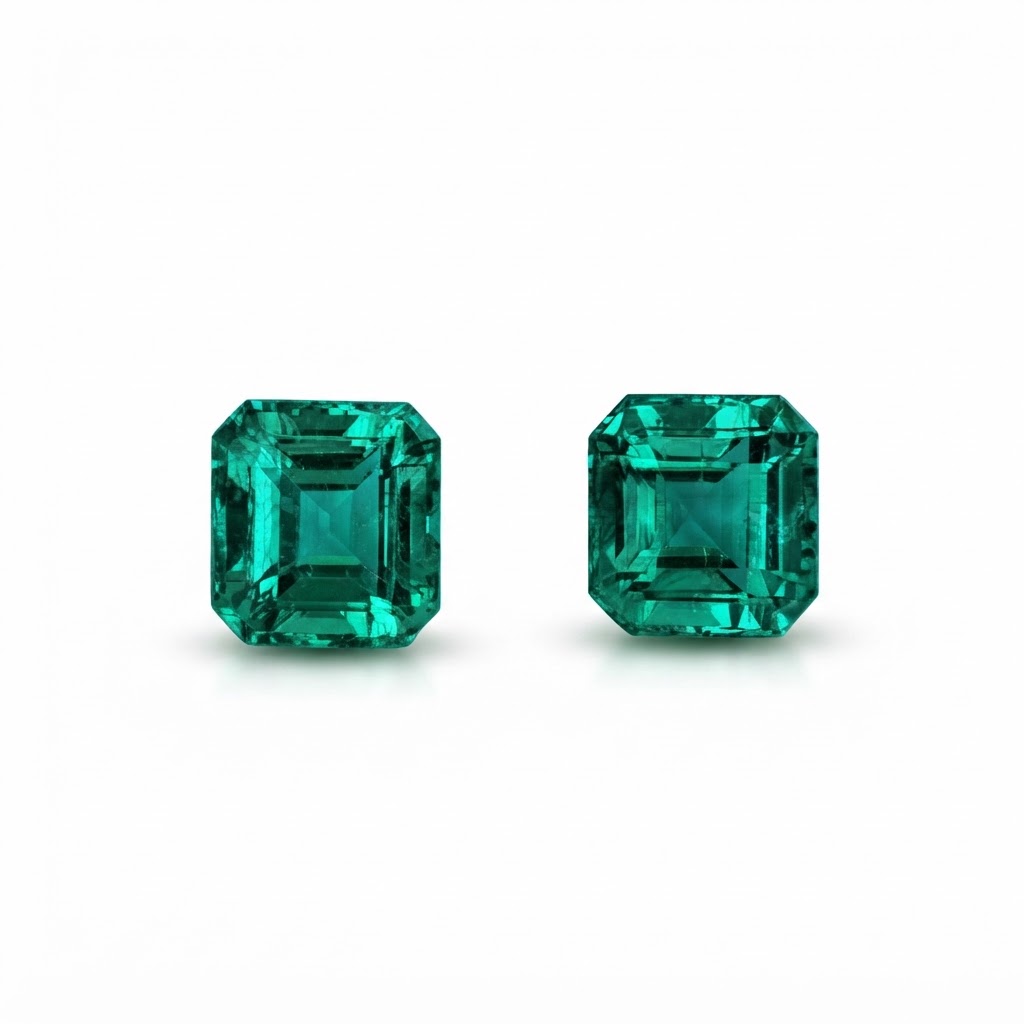 Actual stones pictured
Jewelry for the uncommon
A diamond is the default answer — a beautiful default, but a default. Choosing an emerald is a quiet refusal of the default: older mythology, a color no other gem gives, and a stone most people will never see in person.
The people drawn to emeralds tend to share the quality of the stone. They did not come looking for what everyone else has. That was true of Cleopatra, and it is true of the collectors we work with in our Vault every week.
Find the emerald that stays with you.
Whether you are beginning with a stone or an idea, the first step is a conversation. No detail is required — only an eye.